Advanced Higher Physics
Mandatory Course Key Areas - Aug 2018
Knowledge that an unbalanced torque causes a change in the angular (rotational) motion of an object.
Definition of moment of inertia of an object as a measure of its resistance to angular acceleration about a given axis.
Knowledge that moment of inertia depends on mass and the distribution of mass about a given axis of rotation.
Use of an appropriate relationship to calculate the moment of inertia for a point mass.
Use of an appropriate relationship to calculate the moment of inertia for discrete masses.
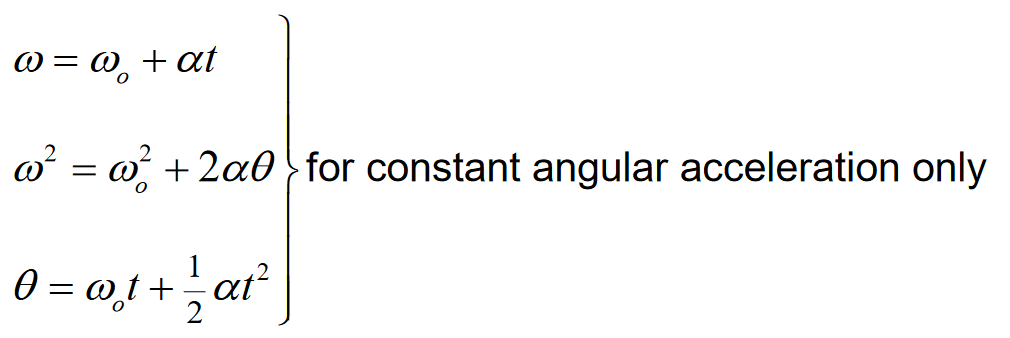
Use of appropriate relationships to carry out calculations involving angular and tangential motion.
Use of appropriate relationships to carry out calculations involving constant angular velocity, period, and frequency.
Knowledge that a centripetal (radial or central) force acting on an object is necessary to maintain circular motion, and results in centripetal (radial or central) acceleration of the object.
Use of appropriate relationships to carry out calculations involving centripetal acceleration and centripetal force.